

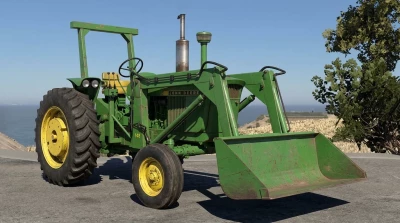


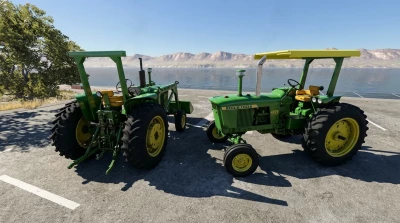
Classic John Deere 3020/3010 tractor (produced 1960–1972) for BeamNG.drive. Prepared for "Career" mode: all configurations can appear for sale from private sellers and are eligible for insurance (commercial class).
Configurations:
- 3020 Diesel (base): 4.4-liter four-cylinder engine, 71 PTO (power take-off) horsepower (per Nebraska Test No. 940), Syncro-Range transmission (8 forward / 2 reverse gears), factory muffler.
- 3010 Diesel: 4.2-liter engine, 59 PTO horsepower, straight galvanized exhaust pipe.
- 3020 Diesel ROPS Canopy: equipped with a Roll-Over Protective Structure (ROPS) featuring a John Deere "Roll-Gard" canopy and a curved chrome exhaust pipe.
- 3020 Diesel Ballasted Workhorse: a ballasted version featuring cast-iron rear wheel weights, front-mounted weights, deep-lug rear tires, and 7.50-16 front tires.
- 3020 Diesel with John Deere 148 Loader: includes an original John Deere loader (72-inch bucket), cast-iron rear wheel weights, a ROPS, and a factory muffler.
- 3020 Diesel JD 148 Loader with Pallet Forks: equipped with a John Deere 148 loader and pallet forks; an additional set of pallet forks is also mounted to the three-point hitch. - 3020 Diesel with Duals and Stacked Weights: equipped with Firestone dual rear tires, two sets of cast-iron wheel weights, and front-mounted weights.
- 3020 Diesel Farm Stock Puller (8,500 lb / ~3,855 kg class): features a factory engine, standard tires, and a stock drawbar; additional equipment is limited to front and wheel weights.
- 3020 Hot Farm Puller (9,500 lb / ~4,309 kg class): powered by a turbocharged engine (~300 hp at 3,000 rpm) and fitted with a tall, open exhaust stack, 16.9-38 pulling tires, a front weight bracket with an integrated hitch point, wheelie bars, and an emergency air-shutoff system; the three-point hitch has been removed.
- 3020 Gasoline: equipped with a 227-cubic-inch, four-cylinder gasoline engine (64 PTO hp, per Nebraska Test 851).
- 3020 LP (Liquid Propane) Row-Crop with Roll-O-Matic front end: features a gasoline-equivalent engine (65 PTO hp, per Test 852) with a fuel tank dome protruding through the hood, mounted on a narrow, dual-wheel Roll-O-Matic front suspension.
- 3020 Diesel with Power Shift: includes a factory 8-forward/4-reverse Power Shift transmission and a Roll-Gard canopy.
- 3020 Gasoline with Power Shift and single-wheel front end: configured with a single 7.50-16 front tire mounted on a fork. - 3020 Diesel with a 606 rotary mower, road kit: 6-foot JD 606 three-point hitch mower, seat umbrella, SMV (Slow-Moving Vehicle) emblem, and fender-mounted warning lights.
Loader:
John Deere 148 (3.2m to the pivot pin, 38-degree dump angle); listed under "Front Loader" in the parts menu.
- T/G keys: raise/lower the boom. K/I keys: dump/curl the bucket. Gamepad: hold the modifier button, use the right stick to raise/lower, and the left stick to tilt.
- Loader control levers (located to the right of the seat, in front of the right fender; labeled "BOOM" and "BUCKET"): these move in sync with the controls and can be operated using the mouse. Click and hold on a handle to pull the lever back (raise the boom/curl the bucket); use Shift + click to push the lever forward (lower the boom/dump the bucket).
- The hydraulics are powered by the engine-driven pump, meaning the loader operates faster at higher engine RPMs (use the hand throttle while working).
- "Loader Attachments": includes a 72-inch material bucket or a pin-on pallet fork frame (with two 42-inch tines and a 48-inch frame). Both attachments connect using the same two pins, so the tilt cylinders operate the forks in the same manner as they do the bucket. - "Three-point hitch": 42-inch pallet forks (which remain horizontal as the hitch is raised) or a John Deere 606 rotary cutter (see below).
John Deere 606 Rotary Cutter:
- 6-foot (approx. 1.8 m) cutting width; equipped with a swiveling tailwheel. It is powered by the rear power take-off (PTO). Pressing the **O** key engages the PTO, driving the blades—via a gearbox—at approximately 890 rpm (note that the blades will continue to spin due to inertia after the PTO is disengaged, until they come to a complete stop). The cutter can be raised using the three-point hitch (Y / U keys) to facilitate turns.
Tractor Pulling:
- The pulling sled chain attaches to the drawbar hitch pin (positioned 0.49 m high and 0.65 m behind the drive axle—within standard requirements of 20 inches / 18 inches).
- "Pulling Kit" slot: Allows for the installation of anti-tip bars (wheelie bars) and a mast for an emergency engine kill system (the three-point hitch must be removed first, as its lower links occupy this space).
- "Front Weights" slot: Allows for the installation of factory-style ballast weights ("suitcase" weights) or a specialized bracket that includes its own front hitch point.
- Weight classes for participants account for the driver's body weight (80 kg).
 Report file



COMMENTS
There are no any comments
Write a comment