

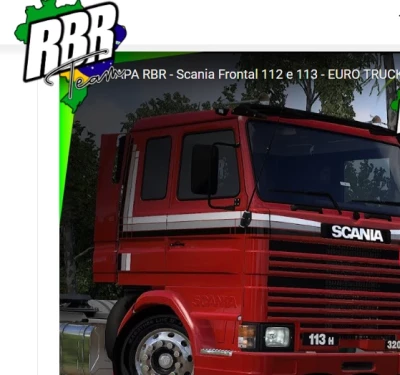


The Scania 112 and 113 are two of the most iconic and beloved heavy-duty trucks ever produced by Scania do Brasil. They are part of a lineage of "cara-chata" (flat-faced) trucks that dominated the Brazilian roads for decades. While they share a similar robust design, the 113 was a significant evolution of the 112, bringing more power, comfort, and technological advancements.
### Scania 112 (Série 2)
The Scania 112 was launched in 1981 as the successor to the successful 111 model. It was a major step forward, featuring a new, more aerodynamic cabin design (which had been tested in a wind tunnel) and a focus on driver comfort.
* **Engine:** The 112 used a 6-cylinder, 11-liter diesel engine. It came in several power options, including naturally aspirated and turbocharged versions.
* **Power:** The most common and famous version was the 112 HW, which had an intercooler and produced around 360 horsepower.
* **Features:** The 112 was known for its simplicity and mechanical durability. It introduced improvements like a more comfortable and quieter cab, and some later versions came with air suspension for the cab. The "H" in the model name often referred to its high-power engine, making it suitable for long-haul transport.
---
### Scania 113 (Série 3)
Launched in 1991, the Scania 113 was the third generation of the brand's heavy-duty trucks. It built upon the success of the 112 by introducing a number of key improvements that made it a legend in its own right. The 113 is widely considered one of the best trucks ever made.
* **Engine:** The 113 continued to use the 11-liter engine but with significant internal upgrades, including changes to the pistons and cylinder heads to improve combustion and efficiency. The most powerful version was also known as the **113H 360**, with the intercooler providing a substantial boost in performance.
* **Power:** The 113 offered more power and torque than the 112, with the 360 hp version being a staple for its time. This made it even more capable of handling heavy loads and steep inclines.
* **Transmission:** It received a new series of transmissions, including more refined gearboxes with better synchronization and a wider range of ratios, which improved drivability and fuel economy.
* **Features:** The 113 featured a more modern and ergonomic interior, including a redesigned dashboard. Later models also introduced the famous **Topline** cab, which offered a higher roof and more interior space, setting a new standard for driver comfort.
---
### Summary of Key Differences
| Feature | Scania 112 | Scania 113 |
| :--- | :--- | :--- |
| **Engine** | 11-liter, 6-cylinder | 11-liter, 6-cylinder (with internal upgrades) |
| **Power** | Up to 360 hp (HW version) | Up to 360 hp (H version) with better torque/efficiency |
| **Transmissions**| Manual gearboxes | More modern, refined gearboxes with better ratios |
| **Cab** | "Cara-chata" cab with some comfort features | Introduced the more spacious and luxurious "Topline" cab |
| **Legacy** | The groundbreaking predecessor, a workhorse | The legendary and refined evolution, a symbol of durability and performance
In short, the 112 was an excellent truck for its time, but the 113 improved on almost every aspect. It took the proven mechanical reliability of the 112 and combined it with better performance, a more comfortable cabin, and a touch of modern luxury that cemented its reputation as a classic.
 Report file


COMMENTS
There are no any comments
Write a comment