

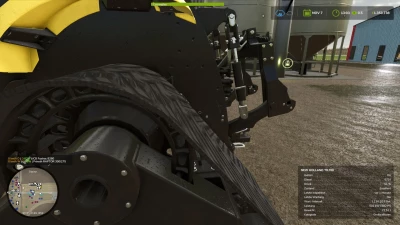
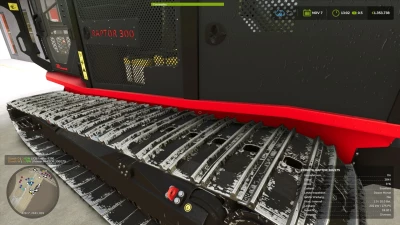
This mod adds a standalone and significantly more detailed wear system for tires, rubber tracks, and steel tracks to Farming Simulator 25.
Tires and track systems wear down based on the actual distance traveled, slippage, and various other factors. Your driving style, the terrain, weather conditions, the weight being moved, and dynamic load distribution across your wheels or tracks now all play a role. Wear is tracked and saved individually for every vehicle and every wheel or track unit, making it independent of the standard GIANTS vehicle wear system. This applies to all vehicles owned by your farm—whether purchased, rented, or leased. AI traffic vehicles, vehicles from other farms, or machinery "rented" specifically for a mission are not tracked.
The goal of the mod is to visually represent realistic wear on wheels, rubber tracks, and steel tracks, accurately reflecting the current level of wear. It supports standard wheeled vehicles as well as machines equipped with rubber tracks or steel tracks. Trailers and implements with their own wheels are also included and tracked. For rubber and steel track systems, the wear calculation accounts for road wheels based on their actual design, displaying them separately via a combined icon. Most in-game vehicles and many mods have been tested; while 100% compatibility isn't guaranteed, it is well over 90%. There may be isolated cases where tracking isn't yet possible—such as with two-wheelers, three-wheelers, or specialized machinery mods—but work on compatibility is ongoing. For specific mods, I require the mod files themselves—including i3d files, UV masks, i3d mappings/shapes, and vehicle XMLs—to determine if implementation is feasible. As wear increases, the visual appearance isn't the only thing that changes; heavily worn tires lose traction, thereby affecting handling. This introduces a shift in inertia or a lag that causes the vehicle to slide—whether accelerating, braking, or turning. Tires, suspension components, and track rollers can be replaced at the workshop; costs factor in the vehicle type, the number and size of tires or track components, and a small multiplier based on the selected reference mileage.
The desired reference lifespan can be adjusted in the settings. Options include 350, 500, and 750 km for smaller or classic 2×2 maps, and 1000, 1500, and 2000 km for larger 4×4 maps and longer periods of operation. It is important to note that a 1000 km setting does not guarantee the tire or suspension will last exactly that long; the reference value simply serves as the basis for calculating wear. Consequently, the component might last less time—or potentially longer—depending on driving style, the nature of the work, and the load.
Furthermore, the mod supports wear calculations for AI-controlled vehicles—specifically those using Courseplay, AutoDrive, or the built-in Giants AI. To ensure this works smoothly, I developed an electronic immobilizer that locks the vehicle until the startup phase and system initialization are complete, preventing any external input during that time. This is necessary because Courseplay and AutoDrive bypass the standard startup sequence intended by Giants, which could otherwise lead to glitches or unintended issues. Think of it as a "Parking Brake 2.0": once the vehicle is ready to go, the immobilizer disengages, and everything operates as usual.
The mod also introduces three penalties. The first is a loss of traction in tires and suspension components, which worsens as wear increases. However, you will still be able to drive the vehicle to the workshop, albeit with certain limitations and—depending on the situation—without a trailer. Additionally, there is a speed penalty in AI mode: the AI cruise control is throttled down to as low as 20 km/h, depending on the level of wear, to ensure the vehicle and its path can still be controlled. At normal speeds, the AD system is no longer able to compensate for tire slippage and loss of traction. If you drive the vehicle manually, there is no speed restriction, though you will still face the corresponding handling limitations.
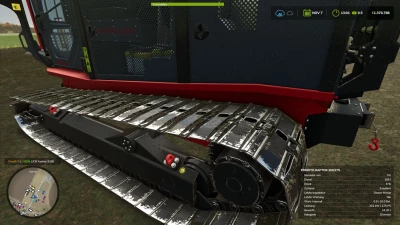
Thirdly, there is a maximum speed penalty for tracked vehicles (both rubber tracks and metal tracks). Depending on the wear of the inner road wheels, the maximum speed can be reduced by up to 50%. Once the road wheels have been replaced, the penalty is removed.
- 0 Likes
- 0 Comments
- 5 Downloads
-
 5
Downloads in
5
Downloads in
-
 1 hour ago


 Report file


COMMENTS
There are no any comments
Write a comment